Friendship Skills for Neurodivergent Adults
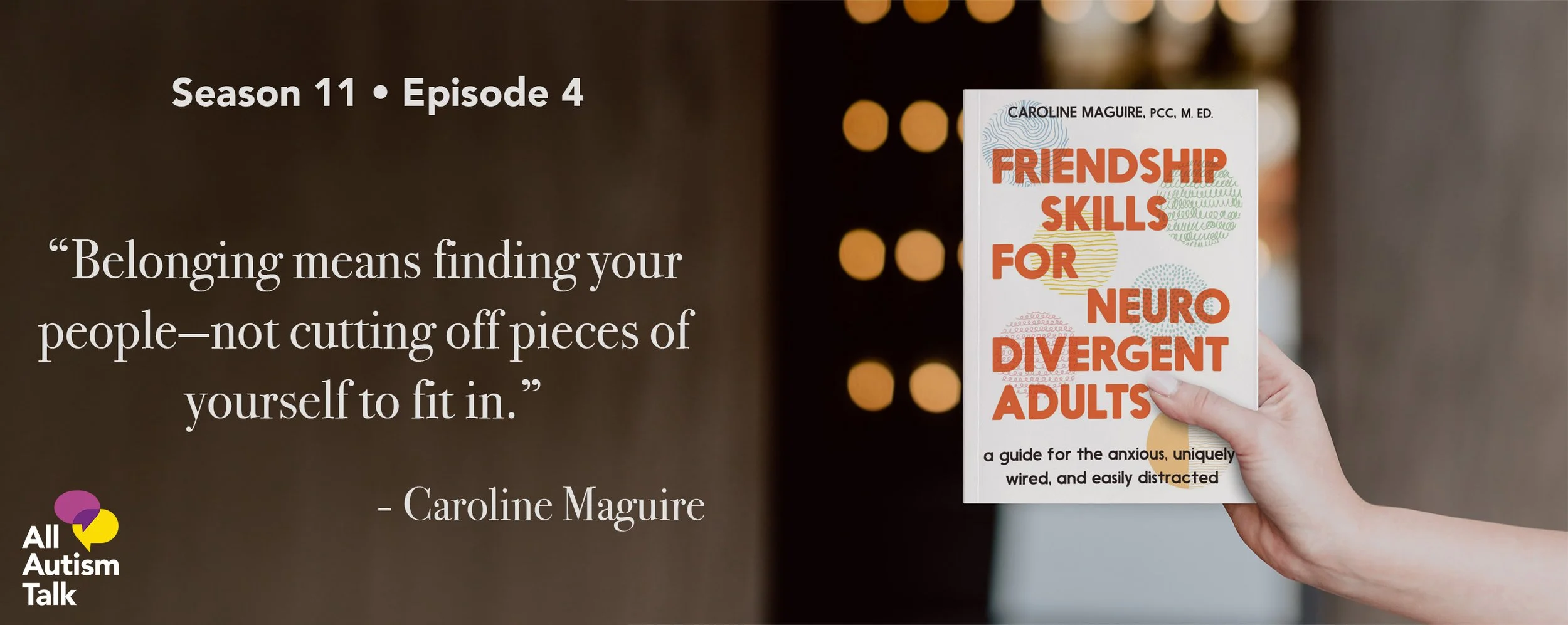
In this episode, Caroline Maguire explores the nuances of friendship through a neurodivergent lens, drawing from her book Friendship Skills for Neurodivergent Adults. She shares personal insights on social challenges, the difference between belonging and popularity, and the impact of masking and mismatched communication styles. Caroline introduces her “Three P’s” of friendship—Proximity, Practice, and Participation—as a framework for building meaningful connections, while also unpacking how friendships can evolve, from seasonal to lifelong. This conversation offers practical guidance, research-backed insights, and an empowering reminder to honor your own unique path to connection.
-
-
Richie Ploesch
Caroline, thanks for joining us this week. It's great to have you.
Caroline Maguire
I'm so happy to be here.
Richie
we have a ton of questions. I have a ton of questions for you, but I want to start with, your book, friendship skills for neurodivergent adults. Why do we need this book? And let's start there.
Caroline
You know, I think that we need the book because most of the friendship literature that's out there is for typical people. Or it's very academic, like the average person couldn't pick it up and read it and, you know, and have a clear path. I also think that this is literally the first book by a neurodivergent person for neurodivergent people for adults. And with diagnostic rates exploding the way they are, which I'm happy about because I think so many people have been sort of left out. I really think that it's time because in all of the ways that our communities have come together, we've come together and basically said, we want things to be neuroaffirming. We don't want a mask anymore. And I think that is a long time in coming and overdue.
Richie
I absolutely agree. And I think, you know, Scott, some of those things that we've talked about this on episodes previously, but sometimes you sit down and they, some of the, the, the strategies are just so scripted and so robotic and, there's, they're just so overwhelming at times. I don't know. I just appreciate that we're having this conversation today. So thank you.
Caroline
Yeah, I think they can be really overwhelming. And I think also a lot of strategies don't keep our brains in mind. I'm like, well, if I could self-regulate that well, I would self-regulate that well. That's very nice of you, but it's not possible. So I think that that's the thing. We need something that sort of says you get to choose your own friendship path. And if that runs down your battery too much or your social cup is filled up by parallel play, right? know, autistic folks are, parallel play is a thing, even in adulthood, that you don't have to friend the way people told you when you were a kid. You can friend what works for you.
Richie
Yeah, I mean, I think that brings up a whole a whole concept of, you know, how do you define a friend and friendships are dynamic? They're changing. They're shifting all the time. I have some friends that I enjoy going out to restaurants with and some friends I enjoy going to concerts with, but they may not be the same friend.
Caroline
Right. And we have friends for different seasons. And, you know, sometimes someone is an activity buddy. You know, there's someone you just see in an activity. And I think that one of the things that's been hard for us is to, you know, move people from sort of that acquaintance stage to a real friend. And so I deal with that a lot in the book, because I feel like there's reasons too that we can troubleshoot that can help you figure out how to grow that relationship more if that's what you want. And again, the books that are out there, they're for typical people. Maybe typical people get stuck in this too, but that's not what I hear. I hear it from our community.
Richie
Yeah, we're diving into the book already, but I want to back up. No, no, it's I want to back up a little bit and you've been pretty open about your own neurodivergence and social struggles. How did your personal experience shape the way you wrote the book?
Caroline
Well, I think it's really, it's, you know, it's funny. Sometimes you have experiences and you don't think like, you know, you're like, this stunk and you didn't realize that it really was meant to be. And I feel like because I struggled and because I'm not, I'm not perfect at this, I always say, I'm not, I'm not claiming to be perfect at this. I'm just the person who thinks about it all the time. And so I think, you know, I had, I was bullied a lot as a kid. I was an old soul. I, you know, I was definitely, I was definitely unique. You I went to school talking in a British accent. I talk about all this in the book. I had some unique things that I did that didn't go over very well. And I definitely struggled. And I've had some of the patterns that neurodivergent folks have, like rushing into friendship and calling someone a friend who is really an acquaintance or, or, you know, having lopsided relationships because I had lower self-esteem and I took things that I shouldn't have taken. So I really think it matters. have ADHD, have dyslexia, I have a lot of learning disabilities, actually those have been actually one of the reasons that things were a struggle for me, not so much as my ADHD. I mean, think that was a struggle, but you know, just the fact that I, we didn't know about dysgraphing. This is the eighties. We didn't know about dysgraphia. We didn't know like, why can't she catch a ball? So I feel like I also understand when people are scared to do this, when this is a taboo topic, when they're like, I don't really know if I want to try to make friends because it's been so hard. I do understand and I think that's important.
Richie
Yeah, absolutely. You said something that made me think of you said in the 80s and I thought of my parents who were saying, just go and do that. Like, don't make it complicated. Just go and do it. It's like, well, how? Like I have an idea of how to do it, but how do I actually put that into practice? And the amount of times that I stumbled and fell, not literally, but figuratively into friendships, it just makes me think it's not that easy. It's not as easy as just go and say hello and then it'll go from there.
Caroline
I think that's one of the myths we should banish. if I could, you know, if I could do anything, I would get people to banish this myth that it's easy. Because I think even for typical people that it's hard. I mean, we have a worldwide loneliness epidemic, right? And I just think that they understand things on a different level. And I think that we, you know, we're often bottom-up processors, right? So we come to the world with a different view. But I think that that whole like, shame cycle that's brought on by the feeling that it should be easy. So if it's not easy for me, there's something wrong with me I would love to banish that because I think it is hard and I think there's a lot that goes into it and And that's why the book you know has a lot in it in terms of strategies because I wanted people to see themselves and to have answers for themselves and
Richie
Mm-hmm.
Caroline
And you know, I think that sometimes this is a scary topic for people. They've been burned before.
Richie
Absolutely. Yeah. so many times I worked with a group of young adults and teens and we spent a lot of time talking about social skills and we talk a lot about dating and, you know, when you said sort of the lopsided investment that made me think of, I've got a student who falls in love regularly and out of love equally as quickly. And you know, on Tuesday was, I'm so in love. And then Wednesday it's the relationship's over and it didn't go anywhere. And, and the hard part for so many that I hear from them is they hold on to all the things that they did wrong and they latch on to the failures and not the successes because the failures are more pronounced. At least that's part of it.
Caroline
Yes. Yeah. And I want to say this. I think there's a lot in here that teenagers and young adults can use. mean, I work with all ages and you know, I use strategies from, this book with teenagers every day. and then I use them with adults who are 60, you know, like I use them with all ages. And I also think there's this thing that you're describing where a lot of, nerd virgin adults, you know, they come to me at first and they're saying like, I had this great experience. And then by the end of the session, they've sort of rewritten it as like it was an utter failure. And that's kind of the like, I'm in love, no, it's a disaster. And I talk in the book about all or nothing thinking, but I also think because we've had a hard time, I think there's a tendency for us to have so much self doubt that.
Richie
Yes, yes.
Caroline
you know, we start the conversation saying like, had this great experience, I had this great chat with someone, but then because we're scared, because things haven't worked out in the past, we're easy to reframe it, you know? And this isn't me running anyone down. I used to do it too, where then it becomes like, it was a failure. I think that's another thing I talk about in the book is sort of honestly looking at your wins. Like if you got somewhere and you went there and you are a person who struggles like pat yourself on the back. That's a huge win. And maybe that's all you do today. You just show up. You don't even talk to anyone. Like you went there and you showed up and you, you did it. And like to really celebrate that. And again, this goes back to we're throwing away all of the, what you should do to make friends, all of that stuff from the past. Cause it, it does not necessarily, it doesn't help us.
Richie
Yeah. Yeah. I like that idea of it could be that you just go just getting there as part of it. mean, just just sending an email, just sending the text, just scheduling the event right when you when you think about all the pieces when you back up and think about all the pieces that it takes to get to a coffee with somebody. How many communications of I'll be here at this time. Great. We've never met before. I will be wearing this. I don't know whatever you know.
Caroline
Yep. Yep. Yeah.
Richie
Am I in the right place? I have to now navigate transportation to get to this place. mean, there's a lot just to get to the coffee and then the coffee is its own event and it requires its own navigation.
Caroline
Yeah, and I think like one of the things I have in there is one thing you can try today. And, you know, what I say in the introduction is maybe you just read this book and that's all you do. Or maybe you do the one thing to try to today in each chapter and that's what you do. And for people who are really scared and this is really hard for them, you know, that is a big step. So I want people to know that they can do little steps and move forward and then the book is always here. You can go back and start at the beginning and keep growing. I just feel like too much of the time you sort of hinted on like childhood and how our parents used to say like, just go into the yard and talk to people. I think so often people talk about friendship and they talk about like, go do this epic thing. And if you've had a hard time, like that's daunting. So you stay on your couch.
Richie
Yeah. Right, Avoid it altogether. Right.
Caroline
Right? Why, would we even start? It's like climbing a mountain. So why would I do that? You know?
Richie
Yeah, I want to. I want to make sure I apologize to my mom real quick and say I love you mom. If you're listening, I didn't mean to say anything bad about you on there. Anyway, OK, back to it. One of the things that you talk about is the difference between. Belonging versus popularity. Can you can you explain a little bit of the difference between that for us?
Caroline
Yeah, I think there's a big difference between fitting in, right? Which means you do anything you have to do. You people please, you mask. Versus belonging. And belonging means that those are your people. They accept you as you are. You feel included. You feel safe emotionally. And I think, you know, popularity is something where you're...
you are pleasing the crowd. And so I think we as neurodivergent people, what's really come out through the internet since the pandemic is really a desire for belonging and a desire for acceptance. And I totally think that that's, I think that's what most people want, right? We want to find our people, not just fit in and cut off pieces of ourselves.
Richie
That's a lot to think about.
Caroline
I mean, I think we just start with like, you know, in the unmasking chapter, I talk about like, what are your preferences? What are your needs? And like, what do you want in a friendship? you know, who are your people? And sort of doing that exploratory work. When we date, we do that, right? I work with clients and they'll be dating and we spend like two sessions on this hinge profile and then when it comes to friendship, they're just like rushing in and taking whatever they can get. And I'm like, wait a minute, we just spent like a million years on, you know, online profiles, which is fine. And we taught a million talks about like what you want in a partner, but like, what do you want out of friendship? And it's different for everybody. Some people listening to this are going to say, I want someone to do this like one niche activity with. Great.
Richie
Yeah.
Caroline
Some people are gonna say, I want a really close friend. I only have acquaintances. It's what you want. You you get to choose.
Richie
Yeah.
You've mentioned the term masking. I think once or twice. Can you unpack that for us for the listeners who maybe aren't familiar with that term?
Caroline
Sure, totally. Masking is a term that means basically camouflaging or hiding your neurodivergent traits so that you appear more typical. And I think there's a difference between masking and adapting. Adapting to me is a temporary thing. It's reading the room and shifting what you're doing in order to meet what's going on it doesn't feel painful, right? Adapting shouldn't feel painful. Whereas masking is really what we do when we, you we don't fidget, we don't stim, we don't tell people that we have sensory issues. And it's a big thing that many people in our community experience and it takes a lot to unmask. So I have a chapter on masking but I will tell people it's a journey and it takes time.
Richie
Yeah, I like I appreciate you explaining the difference. mean, as you were describing that, I was thinking about myself and things that I do, and I'm constantly fidgeting. I'm doing it now, right? I'm playing with the pen. I'm biting my fingernails like I all the things that that are happening and I I but those are ones that are a little bit more socially accepted. And so I can do those at the movie theater and it's not it's not as it's not viewed different.
Caroline
Me too, me too. Right, and I think, know, and some people don't agree with this and that's part of my thing, you know, take what you like and then throw away the rest. That's part of what I talk about in the book. Because a lot of times things in the past for social have been very prescriptive. You must do it this way. And I really think our community has rejected that, and rightly so, so that there are people who, you know, are masked because they - the way they are or the way that they display neurodivergent traits is not as socially acceptable. And I think that there's a way to also explain things to people. A lot of research shows that a lot of our struggles with friendship and typical people and finding our people is about mismatched expectations. That someone's expecting us to respond or to show up in a certain way.
Richie
Mmm.
Caroline
And that if we actually say, you know, that's hard for me. have sensory issues or, you know, I have ADHD. So people fall off my radar. I really want to keep in touch. Or, you know, I'm stimming and this is why I stim that people actually are very accepting of it. And I know that, you know, you can run into people who aren't. But then I would argue, are they your people? Like if they're not accepting and kind, I don't think they're my people and so they have red flags then and I don't want to be friends with them. But I think that the stimming and stuff can be more socially acceptable if we give people some context.
Richie
I want to talk more about mismatched expectations because I imagine that can be broadened to communication styles, communication, excuse me, communication speeds, not just type of activities, but location. I mean, all of those things, we can extrapolate that across a variety. Can you give us maybe a couple more examples?
Caroline
Yeah, so it's known that a lot of neurodivergent people have slower processing speeds, right? And especially if we're in certain environments, right? And so, you know, that's something that comes up. That's a different difference. And so that's where we might have mismatched expectations. People might be waiting for us to reply and we're still processing. And that's where I have this thing called a commune inflation, where you don't have to use a diagnostic label. You can but you don't have to and you can just say, you know, I'm, I'm processing this. Like I sometimes take a little longer to process, but I'm processing this. And then people get like why, why you don't respond right away. Or, you know, if you have sensory needs, the sensory can be a thing that affects us and is a difference. or, know, ADHD people do this thing where we tell a story. And the reason we tell the story is actually to show you, empathy or to show we understand, but it can be misinterpreted as like, why are you talking about yourself? And so I often say to clients like, you know, just say, Hey, I'm going to tell you a story right now. And it's going to seem like, why am I telling this story? But I promise you, it's going to loop back around. And there's a reason I'm telling this story. You know, it's going to make sense with what you told me. And then people are like, okay. You know, so I feel like that we have
Richie
It'll make sense in the end, yeah.
Caroline
I talk in the book about different neurodivergent communication styles and info dumping, right? I personally love my autistic clients teach me so much and ADHD as well. And I was just telling someone today, like I specialize in rabbit holes. Like I love certain things and I go down that rabbit hole on YouTube and I like know, the Royal family is having a bunch of drama. I know everything there is to know. Like I have specialized in this.
Richie
Yeah.
Caroline
And so I personally love it, but I think, you know, people can frame their info dumping. They can kind of flag it and say, this is a nerd version communication style. I do this. Or just even say like, Hey, what you said reminded me of something or like, you know what? actually know about that topic. Like, do you mind if I share? And then people aren't like, what are you doing? but I think it is the way we communicate. think, you know, people do it in order to relate to you. They don't do it just to push out a bunch of information. And I think that's important to know.
Richie
There's so many layers to that, right? There's so many. There's some there's so much there. I want to shift gears a little bit and partially because I'm curious about this for myself. So maybe this is a little bit selfish. I'll apologize for that. But you talk a little bit about the difference between lifelong friends and seasonal friends and something I've always sort of conceptualized is I have different chapters in my life and some people.
Caroline
No, that's fine.
Richie
go from chapter to chapter and some stay in the chapter and when that one's done, it's done. Can you tell us more about that? Can you tell me more about that?
Caroline
Yeah, no, I absolutely agree. I think that one of the things that research has shown, and I always say this because sometimes people are like, well, why should I trust you? Don't just trust me. There's research. I think that we have more than past generations. I think we have people for a reason and for a season. And there's people who come into our lives and they stay for a short time. And then there's people who come into our lives and they stay for a long time. And I also think if you're if you are new to your diagnosis and neurodiversity, the chances are that you are growing and you're changing. And so one of the things I would say is, Caroline 1997 is not the same as Caroline now. Caroline post diagnosis when I was 25 is not the same. So I have some of my original friends, but I would say I don't have all of them. And some of it is that I've changed. And what I want and what I need is different. And I think we tend to, because it's so hard for us to make friends, we tend not to like that. People write me all the time and they're like, people even DM me and they're like, stop saying that that happens because I want it to stop happening. But I think instead of seeing it as a rejection, understanding that somebody might come in and out of your life for a reason. And then,
Richie
Yeah?
Caroline
you know, you get a few close friends over your lifetime. And sometimes you even have close friends, lifelong friends who you don't talk to all the time. My college roommates are like this. But when we see each other or when we talk or even text, we don't have to explain everything that's happened. You know, we can just start off where we left off, you know, and I don't have to explain the context of everything. I can just say, you know, this is what's going on. And they're like, yeah, that makes sense. And I think, you know, there's also an element of looking at what do you want? Like, what do you want out of friendship? Like if people leaving is so painful and hurtful, like where do you want more of, you know, and trying to sort of, you know, the book gives you a pathway toward making more friends and having more of that in your life but it is something that people have to make peace with on some level because it is a change, I think. And I think some of it has to do with the way we move as people now and social media and everything like that.
Richie
Yeah. I've also no, I know I asked that's fair. No, I'm kidding. no, I mean, I appreciate that because one thing that I've just noticed is, throughout my life, as people have moved or as we did, had a different level of proximity, that that's been an impact on some of my friendships and relationships. And I think to your point, it's different now that we've got social media and friends and I can tag and I can send a picture and I can, we can stay connected.
Caroline
So I don't know, you want it to know, I hope that's okay.
Richie
In that way, but it's a little bit different than my college roommate who I saw every day after work and was like, man, today was stressful. Let's talk about that and.
Caroline
Right. It almost sounds like that's something, you know, if that's something you want in your life is to have that, then proximity is a thing. And I have three P's in the book that make up the way we make friends and proximity is one of them. And I think that that's also a thing. So for many of my clients, many people come to me, they're like, I really struggle making friends. And one of the things that I'll talk about is proximity.
because there's research that shows if you show up the same place every Thursday or something, you do end up making friends. There's a little more to it, but I think that that's very hard for some of us, especially with ADHD, it's really hard to follow through, it's really hard to always get there. And I have tips on how to automate things and how to make it easier. But that proximity, have certain phases of your life where the proximity is just built in and then you have other phases where we have to sort of orchestrate it and we have to, you know, join an activity that's high interest and highly interactive and it is and provides that proximity.
Richie
While we're here, I want to hear the other two P's. You mentioned you have three, right?
Caroline
Okay. Yeah. One is practice. I think I'm going to just say, I think a lot of times people struggle with like, I want this to happen really fast. And with sort of, I like people to go into a learning mindset. Like when you're learning, it's okay if you mess up. When you're learning, it's okay if you're practicing. It's okay if everything isn't perfect. You know, it's okay if you, you know, you don't know what you're doing sometimes, right?
Richie
Yeah.
Caroline
and so I really encourage that and I really, there is a participation element. That's the third P is participation. because, you know, I would love it if people came to my couch, you know, I'm fun. You could come and you'd have a great time watching friends episodes from the nineties with me, but that isn't realistic. So whatever you want to do, if you want to have online friends, if you want to join an activity where you have a niche interest and other people will have that interest, I talk about that in the book and how to find those conduits toward friendship. But we have to participate with people and have shared experiences in order to make those friends. And so that's the third P.
Richie
I have this vision in my mind of all these layerings of different types of friendships and different, closeness of friendships and different information you share with each of those things. And it's so easy for this to get really complex really quickly.
Caroline
And I think that's why I'm sort of in the book. really talk about it as like, think about your people, think about a high interest activity that you could join where you have high interaction, right? Cause if you don't talk to anybody, if there's no opportunity to, you can't make friends and go and have shared experiences. And that's your conduit to make friends. And you know, and then here's tips on how to show up. Here's tips on how to make it easier, but it really is, it can feel very complicated but it really does come down to going to these things. And then as you're doing this, right, maybe you do feel like, this friendship lopsided? Am I giving more? And then you go to that chapter and you read about that, right? And you're like, okay, well, you know, what are the green flags for someone's interested in me? Caroline has that. Now that I'm in my activity and I'm doing my thing, I'm gonna look for that. So I think it feels complicated, but just boiling it down, really is about the, you I like us to use what's in our brain, which is that we like high interest things, right? So let's use that. Let's go to high interest activities where we can meet our people.
Richie
Yeah. And I think something else you mentioned in there that I want to highlight is very important is the reflection piece. The, the, did this, I went to this event today and I'm now sitting at home and relaxing and I've got my tea. I don't know. This is me. And, uh, and now I can think about what worked, what didn't, but to do it in an honest way, not a destructive way to do it in an honest way to say, Oh,
Caroline
You have me too.
Richie
Well, I talked to three people who I never met before and that was that success. And this, this fourth person, we didn't really get along and that was okay. We didn't have a great interaction, but I don't have to spend all my time thinking about that fourth person. I can also think about the three that were really positive. And I'm just using that as an example, but
Caroline
But I think that's a great example, right? Because I think there is a tendency to have post-event rumination and to second guess everything. And, you know, I totally get that. And I think it's really important to focus on what I did.
Richie
Mm.
Caroline
and where I felt positive and also to realize not everybody gets to be your friend. You get to choose and you get to discriminate and you get to basically look and see if they have red flags and or if they have green flags. And I know this is like some people are driving their cars, listening to this going, who is this kooky lady that's never happened to me before in my life? But this is what I want for people. Right. And I've seen it happen and I know it can happen.
Richie
Yeah, Yeah.
Caroline
And I talk about my own friendship struggles in the book and where I've taken less. And I want people to know that like, you know, you are great. And some of this is finding people who are like you. And for some people, they're going to say that's other neurodivergent people. I only want to be friends with neurodivergent people. And for other people, they're going to say, I just need to find people with shared interests. And that's the high interest activities as your conduit but I, I do think like celebrate your wins because everybody has one person at an event they don't gel with. It's not just you, you know, like I think that's part of it. It's like we indict ourselves like, I'm the only one. If you went to a typical, typical person, they wouldn't be like, I gelled with everyone.
Richie
Yeah. No, I was at a conference a couple of weeks ago and I was like, man, I really, I was talking to somebody and we just didn't hit it off. We just didn't click. We just, we didn't have anything to talk about and we were nice and cordial with each other. Nice to meet you. Thanks so much. You know, it's a pleasure to hear about the work that you do. And then we both kind of moved on amicably and we didn't spend any other time together at the conference and that was okay. It wasn't, it wasn't a bad thing. wasn't quantified as a failure by any stretch. We just didn't, the way I did with others at the conference where I ended up spending a lot of time.
Caroline
And that's where the practice comes in. And I don't know if this will work for everyone, but I had a client do this and she claims that I told her to do this. And so I'm going to run with it. We're like, maybe you get somewhere and you realize like, these really aren't my people. There's just this distance. just don't click. Okay. Instead of seeing that event as an utter failure, be like, okay, this is practice. I'm practicing my conversation skills. I'm practicing, you know,
Richie
take the credit.
Caroline
meeting people, I'm practicing being okay with the fact that there's no one here that's my people and not to see it as like success or failure because I think, you know, sometimes you go somewhere and you don't click with anyone and therefore like, you know, if you go to an activity, if you're like, and I follow Caroline's advice and she has this big list of activities that might work and I went to the activity and there wasn't anyone for me, like then that's not the right activity. That's just not the right place. But what you did was practice. You practiced being okay with it.
Richie
Yeah. And you still did all the other, all the other mechanics that we talked about scheduling the event, getting to the event, getting dressed for the events, researching, finding the event, all those other things, which is still practice and is still needed and is still helpful. Yeah. Yeah. Right. Caroline, you, your first book, which is called, why will no one play with me was really focused on
Caroline
is yeah and you still should celebrate.
Richie
Really more children, right? And this book is more adults and right. Excuse me. What are you? Are there any common themes that you're seeing throughout the both throughout the two and throughout the lifespan?
Caroline
Yep. I think one of the common things is that if I could, I would. If I could do that easily, I would do it easily. And I think the other theme is neuroaffirming, is to feel good about you, to see your strengths, and to...
Richie
Mm.
Caroline
and to understand your brain. I'm a person who believes you understand your brain, you understand your life, you have a path forward. And I think that I talk a lot about environment in Why Well Known, Play With Me, and parents understanding that certain environments are better for us, certain environments are worse. And I think that's something that carries through with this book some environments don't work for us and we have to curate our environment. And to me that's okay. It's really that I need that. I need that, you know, I can't, I can't swim in all water. I have to have the water to be certain ways. And so I think that's a theme that's carried through. And then I would encourage people, you know, to, to say like, Hey, this is what I need.
Richie
And I, and I am thinking about what you said at the beginning about the different stages of our lives. And maybe it's revisiting that conversation of this is what I need multiple times. Maybe it's every year, maybe it's every six months. don't, whatever that ends up being for you as an individual, but revisiting that to see, is this what I, maybe this is what I needed, but is it still what I need today?
Caroline
I absolutely think so. think our lives change. Your job changes, your home life changes, stressors change. And I think it's okay to say like, this was working before, but I need different things now. And so yeah, I absolutely think that's true.
Richie
Appreciate that context, Caroline. Caroline, excuse me. Can you? Couple takeaways. You wrote this book. You spent some time researching, right? You mentioned there's research out there is research available. These just aren't your thoughts. This is a culmination of. Of a lot more than that. What are some like two takeaways that stood out to you as you were writing that really surprised you like, man, I didn't realize this was going to be something and here it is.
Caroline
No problem. The mismatched expectations was really a big one. I was very, very excited when I found that. And I ran it by a bunch of folks because I read it and I found a study and then I was kind of like, am I right about this? And then I went to a bunch of very heavy hitting people and said, am I right about this? And they were all like, yes. And I found more studies because I was like, not going off just one.
Richie
Mm-hmm. Yeah.
Caroline
I was really surprised by that because that had been my personal experience, but I really didn't know that the research would back it up. And then the other big thing that I was really surprised by is how many people are experiencing friendship breakups and ghosting and like, you know, it's hard to tell cause some of it is like, did we used to track this? Like, did my grandmother track that? I don't really think she did. I don't think they were doing research studies on it back in the 1940s, but I do find that it is on the rise. And it's what a lot of people say to me that they, that they experience friendship breakups, that they experience ghosting. And I think it's so sad. And so I talk about, you know, recovering from that and I talk about the fact that it's on the rise, but I was really surprised and I was, you know, I thought that sometimes in my own practice, but I was like, darn, I don't like that this is actually true, you know? But I do think some of it is some people don't have the communication skills to have a hard conversation. And so all the evidence shows, I just wanna say this for anyone listening, that people who ghost, it's about them, it's not about you. And...I wish people would have those conversations. Like, I just feel like it's just so mean and not nice. But I also, I think that some people just don't know how and they don't have them. And I'm sad about that, but I also want people to remember it's not about you.
Richie
Yeah. Caroline, where can we find more information about your book and when does it come out?
Caroline
So the book comes out April 14th. You can find more information wherever books are sold. So nerd virgin friendship skills wherever books are sold. If you follow me on Instagram at author carolynm, I am gonna be talking about this. I have free giveaways.
there's a QR code at the back of the book if you buy the book with more free stuff. I love free stuff. I'm like one of those people gets really excited about a free pen from a hotel. So I saw this trend with authors of offering like you know more materials, journals, like how do you track this, more questionnaires and stuff and I was like I want to do that because I like love free stuff And so I'm offering that and I'm gonna be doing a lot of like even live webinars where people can come ask me questions and that's gonna be on my Instagram.
Richie
We'll make sure all that stuff gets in the show notes too, so people know where to find you. But Caroline, thank you so much for today and for the work you're doing. really appreciate it. And our community is better for it. So thank you.
Caroline
Thank you. thank you. Thank you for everything you're doing. I appreciate this and I appreciate that I have a new podcast to listen to.
Richie
Great, we'll have to have you back.
Caroline
Thank you.

Friendship Skills for Neurodivergent Adults
All Autism Talk